Birth Plans
A birth plan is necessary – to indicate your wishes for the kind of birth you would like to have. This sets the precedence by adherring to and implementing the elements you’d like, although biological and environmental factors can also influence the outcome, but much less so if you’re able to state your preferences. Doctors, hospital staff, midwives and doulas, whether you’ve arranged your birth at home or in hospital are required to respect and referr to your official written requests, as when you are labouring you should be undisturbed and allowed the space to be fully immersed in the experience, without interruption. This prevents any unnecessary induction practises being performed. Induction methods, although sometimes life saving, often lead to a more unnecessarily rushed, medicalised, disempowering birthing experience for mother and baby. By having your vision and expressing your preferences, you’re able to minimise or completely eradicate this possibility by considering and implementing the following in your birth plan.

Place – where would you like to birth
Home – this is comfortable, familiar, private, safe and perfectly natural with supportive designated professionals, midwives and doulas, friends and/or family present, with a car/taxi standing by in case.
Birth Centre – is a room in hospital but much more homely, with an emphasis on natural birthing. It has comfortable rooms with birthing pools and other birthing equipment, although they tend to be popular and overbooked.
Hospital – sometimes you’re able to request your own room with shower, which is preferable. Otherwise you’ll be on a crowded, noisy ward, labouring until you’re ready to be wheeled in to the delivery room. Sometimes there aren’t even beds available on the wards and you can be labouring in the corridor, under bright lights and passing public.
Private hospitals provide personalised care and private rooms, but are expensive.
Car/Taxi – sometimes it’s difficult to predict when to transfer to hospital. Sometimes the birth can occur in the car or even at the hospital entrance. When it is too early the hospital can send you home again. The transition to hospital can also slow down or interrupt the rhythm of the contractions, along with the change in environment. This is also a good reason for home birth.

Your Team – with good hands to hold
These people are your trusted, chosen supports and advisors, who you state you would like with you in the birthing space. I always recommend you find a doula you connect with well. They are your trained, experienced professional intermediatory, liasing with hospital staff and others. Your voice. They are usually with you continuously throughout the pregnancy, labour, birth and sometimes postnatally if they offer this service also. You may want your partner present, if they are supportive, a family member, a friend or two as back up. Three people are usually only allowed in the hospital room, whereas at home there are no stipulations and you may wish your children present also and make it a family affair, although this can be too much stimulus if it is your first birth, so sometimes less people are better, then you can fully emerse yourself in the experience. Two midwives are assigned for home births, one in hospital, which can often be someone with similar training and values as your birth plan outlines. Home birth midwives can often send trainees, unless you stipulate, especially on second and third births. Ask these questions at your hospital appointments and make sure you have a good doula present that you connect with well, whether at home or in hospital. In hospital you can indicate whether you would like students present or not, which is very important. Otherwise it can be sprung on you suddenly and can become a very pressuring and non private experience. Realistically it is better to have fewer people in the birthing room, thereby keeping it a quiet, insulating, sacred space.
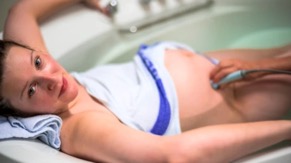
Space – think about the birthing space that you would like to create for yourself. Privacy and safety are essential to a good birthing experience.
Lighting – that is low and soft is preferable, creating a more womblike ambience. You can do this with diffused lamps and candles, led candles in hospitals.
Temperature – is important so heating or portable heaters are needed if it is cold, to keep mum warm so she can move freely. Hospitals tend to be very warm.
Ventilation – can be necessary so it’s airy and doesn’t feel claustrophobic, with windows to open with mosquito netting in summer or a fan.
Scent – you may want an oil burner or air vaporiser with essential oils or room sprays, to evoke a more sacred sense. Certain essential oils assist with the labour, like clary sage which helps uterine contractions, ref Pregnancy Information Document.
Sound – music can also create ambience, to help mum to move and flow inwardly in early labour. Preparing your own playlists with your favourite tracks or a mix of soothing, nature sounds like running water, rain, whale or bird song. Sometimes the comforting, gentle babble and laughter of your birthing team is enough. Positive vibes/energy.
Movement – it is very important for mum to be able to move freely around the birthing space uninhibited. Hip rotations and the birthing preparation exercises, ref doc, dancing, singing and laughter, jiggling and rocking with a rebozo, bouncing on the ball, stair walking, side lying releases, shaking the apple, elephant walking and lunging, help increase oxytocin levels, optimise babies position and descent into the birth canal in the early and later stages of labour. * Spreading hands, feet, fingers and toes, in the latter stages of labour, also helps the process of surrender, exhalation and easeful gentle birthing. Clenching and curling indicates the opposite of pain, injury, tension, contraction, retention and holding the breath. In the later stages of labour these movements allows mum to intuitively optimise babies position and find the birthing position most suitable for her and her baby to emerge, whether it’s in the pool, on a yoga mat leaning on the ball or on the bed holding the headboard on all fours, hanging from the birth sling or from the shoulders of one or two birthing partners, squatting, … Being on your back, feet in stirrups, prevents effective and easeful movement of the baby through the birth canal, as the sacrum is compressed, so this position is illadvised and serves more for easier examinations by hospital staff than for mum and baby. You may need to remove furniture, if at home or push unnecessary hospital equipment to the side.

Equipment – consider what equipment and materials you will need in your birthing room. This may be hiring an inflatable birthing pool for a home birth, an exercise/yoga mat, bolster, birthing ball, sling safely installed, maybe a birthing stool, portable tens machine, foetal heart monitor, candles, Herbal Medics birthing kits, ref Pregnancy Information Document.
Food and Beverages – prepare light, high energy, fortifying, easy to digest, sustenance foods and drinks you and your team would like to eat, like smoothies, juices, soups, energy ball, groaning cake and plenty of water. Labouring can take time, so having food prepared and available makes the experience comfortable for yourself and everyone in your team. Making a month of meals that can be frozen for postnatal consumption is a great help also.
Monitoring – you can indicate whether or not you would like midwives to perform internal vaginal sweeps or not as they can accidentally or intentionally break the cervix mucus membrane causing premature labour which often leads to other inductive medicalised methods. You can speak to hospital staff through your doula or partner, so as not to disturb your labouring, if it is veritably necessary. You can hire a foetal heart monitor, that is secured around the abdomen, allowing movement, through which the doula/midwife can monitor the babies heartbeat and know if there are any irregularities. This gives mum freedom of movement and doesn’t continuously need to be attached. Mum often knows if something is intuitively wrong or right with baby, so trusting the birthing process to unfold naturally also allows this, noting her breathing as a good sign. You do not need to be on your back for any monitoring either, as this is often and only for the convienence of hospital doctors and staff, unless it’s a life threatening scenario, like a C section operation or episotomy, usually unnecessary if you have done your perineal massage well, ref Pregnancy Information Document.
Pain Relief – here it is important to note that some women experience ecstatic, pleasurable, painfree births, without pain relievers and some even have orgasms. This is not uncommon. So this presents the question, how can the same physical act be experienced in a spectrum of ways along this polarity and what can we learn from this about preparing for labour ? Womens perception of labour pain can depend on their country and culture of origin. Some women see it as part of a natural, normal physiological process, not something to focus on or fear and do not request or require anesthesia/pain relieving methods. Also a group of women who gave birth in hospital rated childbirth pain significantly higher than a group who birthed in the familiar, trusted company and comfort of home. Contractions can and do loose power when women are disturbed and the flow of oxytocin is disrupted. Something to ponder, that said here are some natural and medicalised pain relief methods listed below.
Natural – herbal tinctures and teas, homeopathy, acupuncture, nutrition, massage with essential oils and acupressure, heated herbal compresses, hot water bottles, warm water baths and showers, movement, humour and laughter with doula, family &/or friends.
Medicalised – gas and air, epidural, prostaglandin gel or pessary, hormone stimulation of the uterus, artificial rupture of the membranes (breaking waters), syntocinon drip, anesthetic drugs like pethidine and other pain medications.

Third Stage Labour – when baby has been born you can indicate whether you’d like skin to skin, which is essential. Baby is still in a bubble, so the warmth, smell and sound of mums heartbeat is primary directly after birth or with other birth partner if mum is incapacitated. Cleaning, weighing and box ticking can wait.
Cord Cutting – the cord shouldn’t be clamped or cut until it is white, ie. containing no blood so the essential stem cells along with Vitamin K, are allowed to continue passing from the placenta through the umbilical cord to baby. It also prevents retained placenta, post partum haemorrhaging and higher haemoglobin values in the newborn. Waiting to cut the cord usually takes about 10/15mins, so keeping baby covered with muslin or a blanket on mums chest, afterwards is essential. Even if in theatre after a C section.
Vernix – you can also state if you’d like the protective, sticky, white, cream like vernix, covering the baby at birth, usually present when the timing of the birth is ripe, wiped off or not. It is preferable not to and gradually comes off by the end of the first week and is unnecessary to bathe baby for 1-2weeks postnatally, as their skin is very sensitive. Soaked cotton wool/non alcoholic wipes on their bums, muslin wrapping and skin to skin with parents is all thats needed at this time.
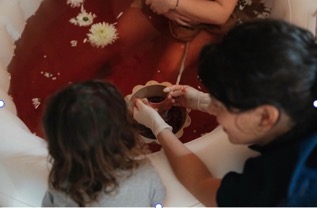
Placenta – the delivery of the placenta occurs next and should also be given time, usually taking about 30mins, ie. no tugging or pulling, vigorous massaging of the uterus, oxytocic drugs are needed to hurry the expulsion, as this can cause postpartum haemorrhaging. If after 15-20mins the placenta hasn’t birthed, helping mum into a seated upright, working with gravity position and maybe some breast stimulation can help. The placenta can then be collected by the Placental Encapsulation professional, who converts it into postnatal homeopathic remedies, herbal tinctures, smoothies, … ref Placental Encapsulation Document. Hospitals tend to want to rush both processes, so this needs to be written clearly in your birth plan and spoken about to your doula, midwife and partners, so they know. If there is bleeding proceeding these measures, which is rare, herbal tinctures such as shepherds purse, blue cohosh or motherwort help with this. When the cord has been cut and the placenta delivered, antiseptic can then be applied to babies navel stump and baby can be inspected, weighed, measured, eyes treated, suctioning of babys mouth and nose, given the vitamin K injection, orally or not. You want to co-sleep with your baby as this is the best way to get breastfeeding off to a good start, especially the colostrum, which is naturally high in vitamin K.
Keep baby close, skin to skin as they haven’t landed completely yet.
N.b – It doesn’t need to be perfect, prepared is good enough, get out of your head and into your body, surrender to the waves, keep your rhythm, go with your flow and enjoy the process, remembering it’s the Life Force energy that propels baby to be born.
References –
Guide to Childbirth – Ina May Gaskin
The New Pregnancy & Childbirth Choices & Challenges – Sheila Kitzinger
How to Have a Baby – Natalie Meddings